Section 106 agreements are often discussed in terms of obligations, funding pots, and delivery milestones. They are framed around what must be provided, by when, and at what cost. Yet for the communities living within new developments, Section 106 is not a legal mechanism — it is a lived experience. It shapes the places they grow up, connect, and belong.
Too often, the sector approaches Section 106 with a doing for mindset: services are designed, facilities installed, and programmes delivered to communities. The intention is positive, but the outcome can feel imposed, disconnected, or underused. This is where an ABCD approach — Asset-Based Community Development — offers a powerful alternative.
What ABCD Really Means
ABCD starts from a simple but transformative principle: communities are not defined by their needs or deficits, but by their strengths, skills, and existing assets. Instead of asking “What does this community lack?”, ABCD asks “What already exists here that we can build on?”
In Section 106 communities, this shift is critical. New developments are often portrayed as blank slates — places waiting to be filled with infrastructure and services. In reality, people arrive with talents, networks, cultures, and ideas. Ignoring those assets risks creating facilities without ownership and programmes without participation.
Why ‘Doing For’ Falls Short
When Section 106 delivery is done for communities, residents are positioned as recipients rather than partners. Decisions are made upstream, consultations happen late, and engagement focuses on validation rather than co-creation.
This can lead to familiar problems: community spaces that feel unwelcoming, activities that don’t reflect local interests, or funding that is spent but fails to build long-term connection. Over time, this erodes trust and reinforces the perception that development happens to communities, not with them.
A doing-for approach may meet contractual requirements, but it rarely builds social capital.
Doing With: A Different Starting Point
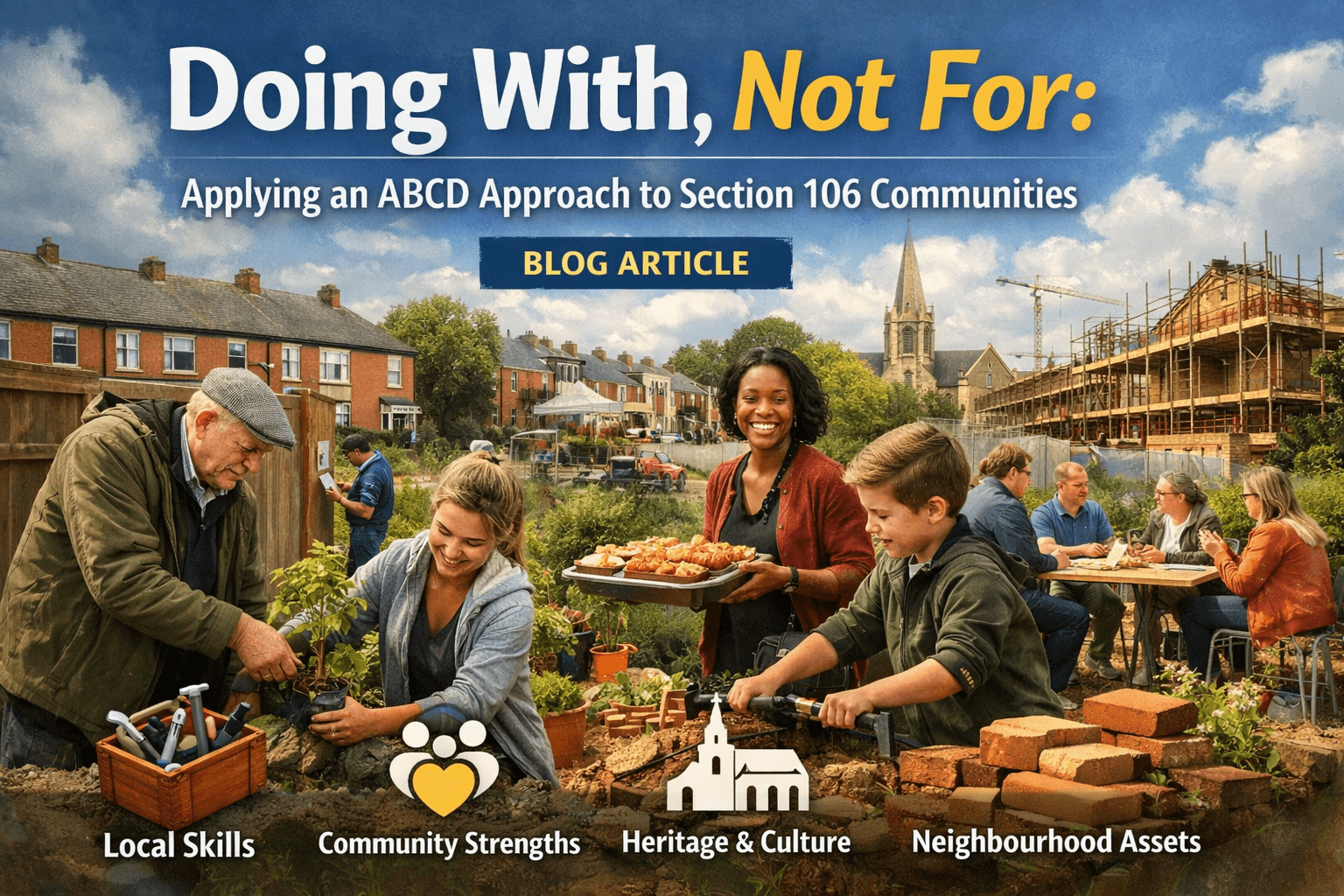
Applying an ABCD approach to Section 106 means involving communities early — not just to comment, but to shape. It means mapping local assets alongside financial ones: resident skills, informal leaders, existing groups, cultural practices, and shared priorities.
Instead of asking residents to respond to pre-set plans, organisations invite them to explore questions together:
- What makes this place feel like home?
- What skills already exist here?
- What would help people connect, not just consume?
This approach recognises that sustainable community development is relational, not transactional.
From Infrastructure to Belonging
When Section 106 is delivered with communities, the focus shifts from outputs to outcomes. A community centre becomes a hub shaped by the people who use it. Green spaces are designed around how families actually gather. Funding supports local capability, not just short-term activity.
Most importantly, residents see themselves as contributors to their neighbourhood’s future. That sense of ownership is what turns investment into impact.
A Cultural Choice
ABCD is not a toolkit to bolt on at the end of a development. It is a mindset — one that requires trust, patience, and a willingness to share control. But the reward is significant: stronger communities, better use of Section 106 resources, and places that feel lived-in rather than delivered.
So as we plan the next generation of Section 106 communities, perhaps the question we should ask is this:
Are we investing in buildings and programmes — or in the people who will turn them into a community?